Four affordable courses about editorial design and typography

I’m not a graphic designer, but I am interested in how they work on magazines, posters, and other written materials. I studied the history of art with a focus on printed ephemera at university, so you could say that this is a lifelong interest.

To learn more about the people who make printed products attractive, legible, and readable, I’ve been auditing courses on Coursera. Here are four courses I’m following at the moment:

Graphic Design Theory – Hierarchy

Graphic Design Theory – Print Design

Textual Elements of Design – Fonts, Typography, and Spacing

Introduction to Typography

All four courses are delivered through videos and short readings. They explain key concepts in a simple and straightforward way. I’d recommend them to anyone who wants to understand why graphic designers still matter in the age of AI. Their work is about far more than “making things look pretty.” They’re communicators who think carefully about how people interact with digital and printed surfaces.

The “Hierarchy” course explains how graphic designers use the appearance and positioning of letters and numerals to help readers find the information they need. The “Print Design” course, led by the same teacher, expands these principles into the world of printed products such as magazines.

The typography courses focus on typefaces (e.g. Baskerville, Helvetica, Arial) and their impact on readers. They both explain technical terms. “Introduction to Typography” does a deep dive into the history of different lettering. I particularly enjoyed that because I tend to notice variations in typeface across different time periods and cultures.

If you know of similar courses, you’re welcome to drop me a line.
Seeing old art with fresh eyes

I attended a series of online evening classes about art history, run by an Italian company called Corsi Corsari. The course format was a weekly lecture, in Italian, with a slideshow. I signed up because I like art and wanted to stretch my Italian listening skills.

I particularly enjoyed learning about Baroque sculpture. The course gave me a fresh appreciation for a style that I had dismissed as overblown and overdone.

Listening to a lecture in Italian was challenging. The teacher needed to pack a lot in, so spoke at the pace of a newsreader. There was also a lot of academic vocabulary that I hadn’t come across before. Fortunately, a recording of the lecture was sent out after each session. Watching the recording allowed me to take regular breaks.

The course benefited my art appreciation far more than it benefited my language skills. Each artwork was on the screen for several minutes, at least. It made me pause and really think about what I was looking at. It wasn’t like going to an art gallery or museum, where a significant part of my attention is distracted by the practicalities of being on a day trip.

What struck me most was that I’d taken so many of the artworks for granted. They’ve been around for centuries and definitely for my whole lifetime, so they’re as familiar as fish and chips.

Looking at some of the outdoor sculptures, I realised what a startling novelty they must have been when new. The people who first saw them didn’t have the fantastical forms of digital and visual entertainment that are available to us today. A statue might have provided some people’s only opportunity to see a particular type of imagery – especially if they worked outdoors and never went inside rich people’s houses. (Of course, churches in Italy tended to be richly decorated.)

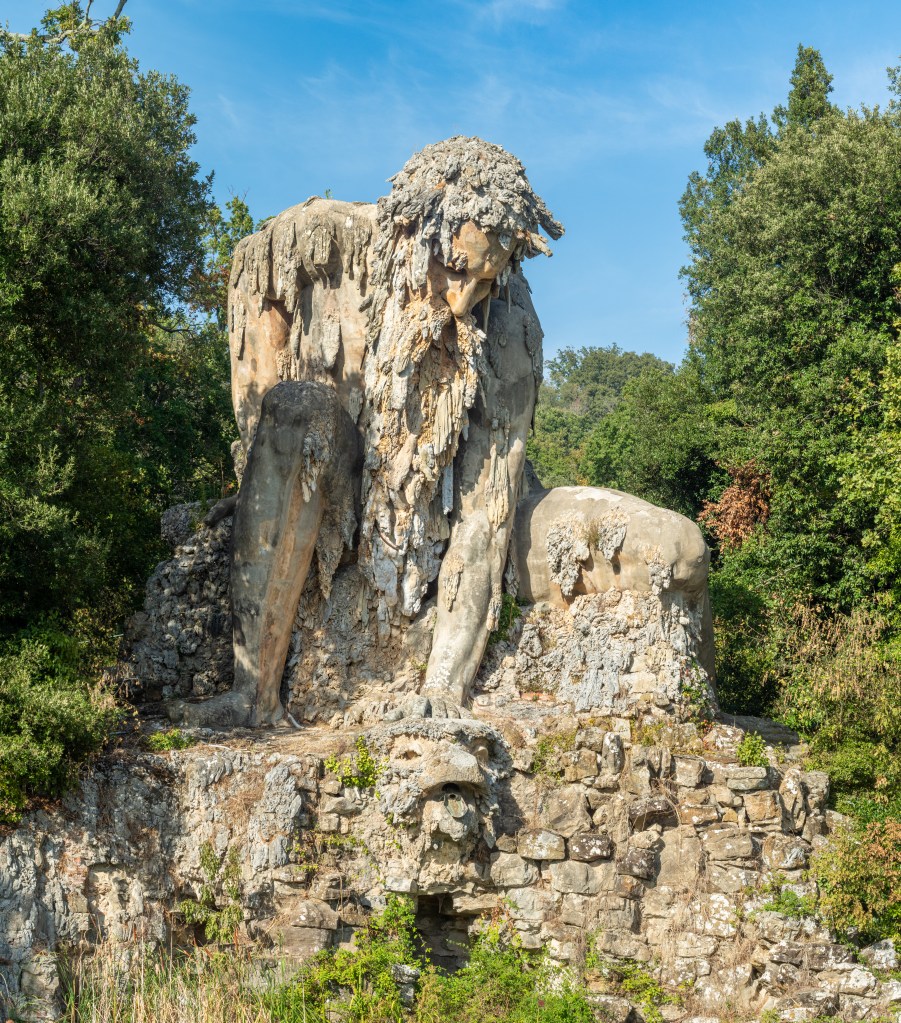
The artwork I remember most is the Appenine Colossus by Giambologna. The statue, pictured below, is 11 metres tall. Imagine what it must’ve been like to see the giant for the first time. I also like to think about the conversations that happened before the work was commissioned. Who decided “I know, let’s put an enormous man on just that spot”?

A statue of a seated giant looking into the water.
By Rhododendrites – Own work, CC BY-SA 4.0, https://commons.wikimedia.org/w/index.php?curid=139570487