Shales are interesting

I’m a freelance proofreader and line editor. My job often involves looking at texts produced in fields of work that I’m unfamiliar with. I prepare myself for that by learning about new subjects in my spare time.

Recently, I’ve been exploring geology. To start with, I had no idea what to expect. I didn’t know what geologists did beyond identifying rocks. The resources I’ve read and watched since then have shown me that geology is actually quite exciting!

Rocks and minerals are a record of events that happened millions of years ago. We live surrounded by ancient history. This was brought home to me by a recorded lecture I watched through my membership of the Geologists’ Association.

It was called “Are ‘shales’ really that dull? Continuing to shine light into dark places and what happens when you open Pandora’s Box!”

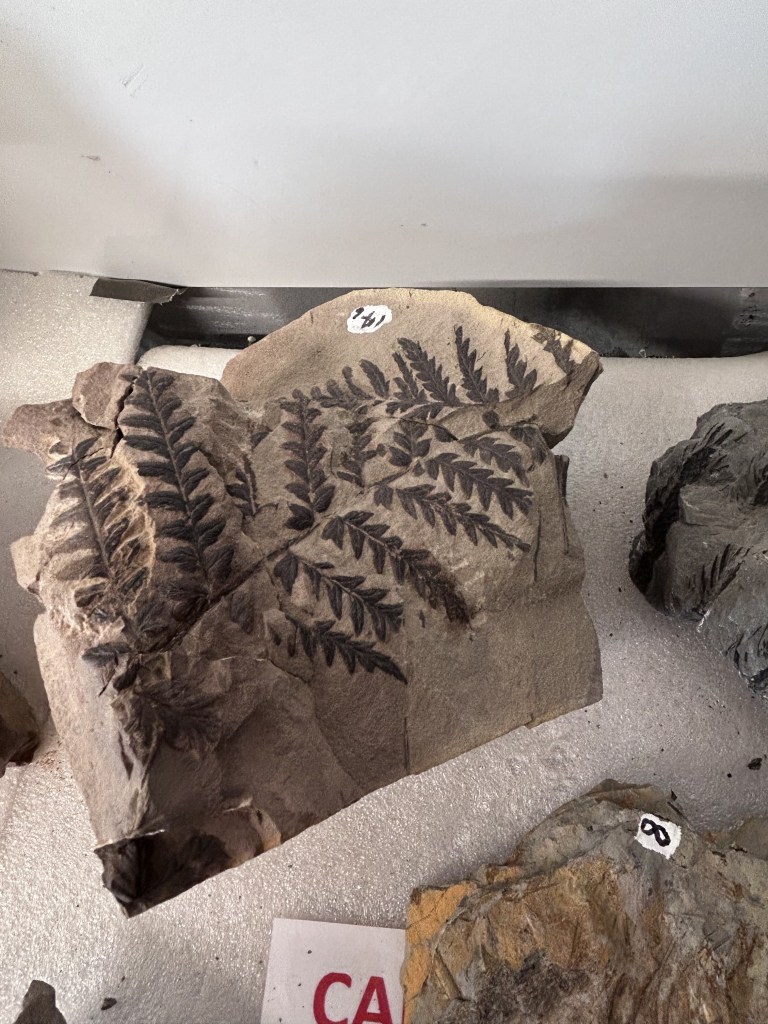
Shales are a type of sedimentary rock. They form in water from layers of clay, mud, silt, and organic matter. Like tree rings and deeply buried layers of ice in Antarctica, they’re a record of nature’s behaviour over a succession of years, long ago.

The lecturer gave the example of a particular cliff and spoke about samples taken from several different levels. The lower samples were millions of years older than the higher ones.

Each sample was thinly sliced and examined under a microscope. It was fascinating because each one looked different, showing what was happening in the water at the time. The lecturer pointed out some short white lines crossing through the layers. These were the burrows of tiny organisms living in the low-oxygen environment of the seabed.

The lecturer also showed a picture of a rock with a beautiful curved line on it. It was evidence of the water current that had deposited the sediment. It was like a photograph of the past.

Many of the details in the lecture went over my head. For example, I had to pause it to look up the meaning of anoxic event. But I appreciated the overall message. I came away understanding that shales are interesting and not at all dull.

I also understood that geologists can work in very fine detail. As a proofreader, I sometimes have to think about the correct placement of tiny punctuation marks. So I can relate to that.

An informal survey of geology content

I made an informal survey of accessible public information about geology. I wanted to see what sparked my interest and what didn’t. I’m a proofreader with a background in the humanities, but I’ve always wanted to know more about rocks and minerals.

Here’s what I looked at. I hope you find these resources as helpful as I have.

Geology Today

Geology Today is published six times a year by Wiley on behalf of the Geologists’ Association and the Geological Society of London. It publishes articles for general readers on all kinds of topics, including reviews of classic books and in-depth looks at particular rocks or minerals. Each issue begins with an entertaining digest of recent geology news (my favourite part).

I’ve read this year’s first four issues. They taught me that rocks and minerals are relevant to literally everything. Our technology, architecture, energy use, agriculture, and development as a species all depend on working with rocks and minerals. If that’s not inspiring, then I don’t know what is.

The Stones of Britain by Jon Cannon

Jon Cannon (1962–2023) was an architectural historian and expert on English medieval church buildings. The Stones of Britain: A History of Britain Through its Geology was his last book. I love the lively curiosity that shines out through Cannon’s writing. I haven’t finished The Stones of Britain yet, but I’m happy to recommend it here.

You might have noticed that the older stone buildings in Britain vary in colour from area to area due to the locally available rock. This makes British geology and British architectural history highly relevant to each other.

The Story of Earth by Robert M. Hazen

Robert M. Hazen is an eminent scientist and mineralogist in America. His book’s full title is The Story of Earth: The First 4.5 Billion Years, From Stardust to Living Planet. It begins with the birth of the universe and goes on from there.

I’ve reached the formation of the Moon (chapter 2). Hazen’s writing is clear and accessible. As a general interest reader, I find it very easy to follow.

Backseat Geologist app

I’ve been trying out an app called Backseat Geologist. It uses your phone’s location to place you on the map. You can press on the screen to read what rocks are beneath your feet or select a longer audio explanation. The binocular icon opens up an account of the landscape in front of you. This looks like a great app to take on long journeys.

Instagram and YouTube science communicators

I’m a bit wary of science communicators on social media. Without any training in geology, I could easily be taken in by AI slop or well-intentioned misinformation. When looking at social media accounts, I prioritised the communicator’s science background and evidence that they were actually human.

I was particularly impressed by @scottishgeologist and @cornwallgeologist on Instagram. These creators also lead geology tours and clearly know their stuff. Luisa Hendry (@scottishgeologist) recently received an award from the Geological Society of London.

My favourite account is @amedeobalbi on Instagram and YouTube. He’s an associate professor of astronomy and astrophysics at an Italian university, so not a geologist at all! Balbi makes fascinating videos answering questions such as what would happen on Earth if the Sun suddenly disappeared. I also enjoyed his video on whether it’s possible to terraform Mars. Watching it, I understood for the first time how much research has gone into understanding the red planet.

What sparked my interest?

My informal survey of these few resources has taught me that rocks and minerals are an all-encompassing subject. They really do matter to everything. It’s easy to see that a lot of geologists are excited about this and are committed to sharing their understanding with the wider public. The human energy around rocks and minerals really sparked my interest.

The study of geologists’ writing is the study of human ingenuity. Most geological knowledge is not immediately obvious to the naked eye. It took centuries of research for humankind to reach the current state of understanding. I find that deeply impressive.

The history of our solar system and the terrain of other planets also drew me in, far more than I expected. Amedeo Balbi’s videos are in Italian, so I had to make an effort to understand them. I stuck with it because they caught my imagination. Again, it is pretty amazing that scientists understand as much as they do about the solar system.

I feel like I should be excited about learning to identify the geological evidence in the landscapes of Britain. That’s not really pulling me in just yet, but I’ll keep going. It may be that my immediate surroundings are still too big a topic for me to get my head around.